The Mediterranean scrub
Herbs of the Mediterranean
scrub
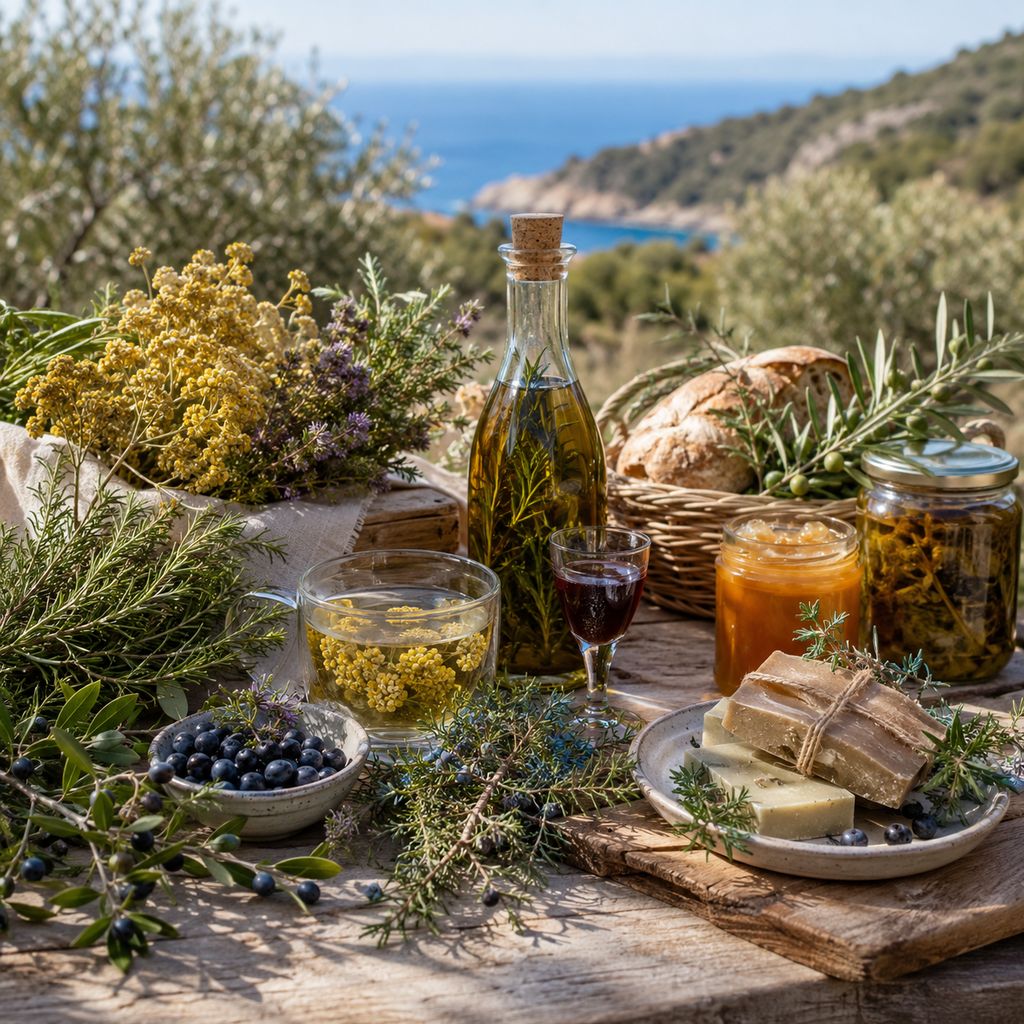
Elba's Mediterranean scrub is an ecosystem rich in wild aromatic and medicinal plants, used for centuries in island cuisine and folk medicine. The six most characteristic species, found on rocky slopes and abandoned terraces, are the protagonists of liqueurs, flavoured oils, herbal teas and traditional dishes.
Grows wild on dry stone walls and coastal rocks. The buds are harvested in June before flowering and preserved in salt.
Fish
Sauces
🌿
Wild fennel
Foeniculum vulgare
Perennial aromatic herb widespread across the island. Tender leaves, flowers and seeds are used. Indispensable on fish, especially raw sea bass.
Raw fish
Liqueurs
🌿
Rosemary
Salvia rosmarinus
The symbol herb of Elba's scrub. Flowers most of the year and produces the famous rosemary honey, awarded "Best Honey in Italy" at Montalcino.
Meat
Honey
Evergreen shrub with fragrant white flowers and dark berries harvested in autumn. The berries are used to make myrtle liqueur — sweet and balsamic.
Liqueur
Flavouring
🌿
Helichrysum
Helichrysum italicum
Aromatic shrubs with yellow flowers, balsamic scent reminiscent of liquorice. Extraction yields a prized essential oil (produced on Elba by La Sabatinaccia).
Essential oil
Herbal teas
🌿
Mastic tree
Pistacia lentiscus
Mediterranean scrub shrub, drought-resistant. The aromatic leaves and fruits have historically been used for flavoured oils and cosmetic purposes.
Aromatic oils
Cosmetics
Historical note — The ancient salt works of Elba: in the municipality of Portoferraio there was a marshy area called "Antiche Saline", active from the Grand Duchy of Tuscany until its regulation by the Royal Decree of 1910. After dismantling, the sea reclaimed the area. Today there is no active sea salt production on the island.
The green gold of the island
Tuscan IGP
extra virgin olive oil
Elba's extra virgin olive oil falls under the Tuscan IGP Extra Virgin Olive Oil designation. Elba's olive groves grow on dry-stone terraces overlooking the sea, especially in Marciana, Schiopparello, Lacona and Bagnaia. Olives are hand-picked in October-November and pressed within 24 hours.
🫒
Tuscan
IGP Oil
TUSCAN IGP
IGP
COLD PRESSED
TRADITION
Extra Virgin Olive Oil
Tuscan IGP from Elba
Elba's extra virgin olive oil is the fruit of a centuries-old olive-growing tradition. Olives grow on dry-stone terraces with a sea view, hand-picked in October-November and cold pressed (below 27°C) within hours. The aromatic profile is medium fruity, with herbaceous notes and a slight peppery finish. The only Elban farm certified by the IGP Consortium is Azienda Agricola Due Palme in Schiopparello (source: Il Tirreno 2014, 2016).
Plant
Olea europaea (Olive tree)
Elba cultivars
Frantoio, Leccino, Moraiolo, Pendolino
Colour
Bright green (new) → gold
Harvest
October – November (by hand)
Certified Elba farm
Due Palme (Schiopparello)
SENSORY PROFILE
🍃 Medium fruity
🌿 Herbaceous (olive leaves)
🥔 Raw artichoke
🌶 Bitter almond
🌶 Slight peppery finish
Why it is Tuscan IGP: Tuscan IGP Extra Virgin Olive Oil is a European designation (EU Reg. 1151/2012) certifying geographical origin and traditional methods. On Elba, the only farm registered with the Consortium's control system is Azienda Agricola Due Palme. Other Elban producers make high-quality EVO oil but without the IGP Consortium certification.
Elba's private oil mills and olive farms (Podere Arduini in Mola, Costagli/Hotel La Feluca in Bagnaia, La Sabatinaccia organic, Due Palme) are detailed in the
Farms — Olive Groves and EVO Oil section.
The nectar of Elba
Elba Island honey:
five varieties
Elba's honey is listed by the Tuscan Archipelago National Park among the islands' traditional products and falls under the Tuscany Region PAT “Mieli di particolari essenze floreali” (honeys from particular floral sources). The five varieties named by the Park are rosemary, thistle, heather, chestnut and strawberry tree (corbezzolo): for rosemary and thistle, Elba is cited among the few Italian production areas.
Strawberry tree honey (Arbutus unedo) is the rarest and most sought-after. The strawberry tree flowers between October and November, when almost all other plants rest, and the harvest comes in December; good years in Tuscany are few, and in the wrong ones Elba makes none at all. It is bitter and astringent, amber, intense and persistent: not for every palate, but it is the Italian honey with the highest commercial value.
Montalcino Award 2002: the rosemary honey of Azienda Agricola Ballini of Cavo (Rio) was judged the best honey in Italy at the national “Roberto Franci” contest of the Montalcino Honey Week, with the top score of 20/20 out of more than a hundred honeys.
🍯
Strawberry
Tree Honey
PAT TUSCANY
PAT
RARE
LIMITED PRODUCTION
Strawberry Tree (Corbezzolo) Honey
Tuscan PAT, listed by the National Park
Strawberry tree honey is one of the very few bitter honeys: a strong bitter, astringent, persistent character, with notes of coffee grounds, chicory and green wood. Bees gather the nectar in October-November, when almost all other plants rest, and the harvest comes between late November and December. Italian production is concentrated in Sardinia, with only occasional good years in Tuscany: that is why it is the honey with the highest commercial value, and in the wrong seasons Elba produces none at all.
Honey plant
Arbutus unedo (Strawberry tree)
Flowering
October – November
Colour
Amber, grey-green once crystallised
Production
Very limited, not every year
Recognition
Tuscan PAT · listed by the National Park
SENSORY PROFILE
🍫 Lingering bitterness
☕ Coffee grounds
🌿 Chicory and bitter root
🌳 Green wood
🍃 Ivy leaf
Why it is a PAT (Traditional Agri-food Product): strawberry tree honey falls under the Tuscany Region PAT “Mieli di particolari essenze floreali”, the list of traditional products recognised by the Italian Ministry of Agriculture, and the Tuscan Archipelago National Park lists it among the islands' traditional honeys together with rosemary, thistle, heather and chestnut. It is not a Slow Food Presidium. Buying it from local beekeepers supports a production that depends on the year.
The other honeys of Elba
🍯
Rosemary Honey
Salvia rosmarinus, spring bloom
Almost colourless to straw yellow when liquid, white-ivory once crystallised, with a fine grain. Delicately aromatic, of herbs, slightly floral, with a mild, short finish. Elba is among the few Italian production areas, and in 2002 the rosemary honey of Azienda Agricola Ballini of Cavo was judged the best honey in Italy at the Montalcino contest. Excellent at breakfast, in herbal teas and with fresh cheeses.
Breakfast
Fresh cheeses
🍯
Thistle Honey
Galactites tomentosa and other thistles, May–July bloom
Produced mainly in Sicily and Sardinia and, in smaller quantities, on Elba, one of the few other Italian areas. Light amber with orange tones and a typical green fluorescence when liquid; it crystallises a few months after harvest into a beige mass. Floral and fruity at first, then vegetal, with hints of caramel and a slight piquancy. Excellent on hard cheeses and in desserts.
Desserts
Cheeses
🍯
Heather Honey
Erica arborea, March–May bloom
Made from the tree heather of the Mediterranean scrub, in flower between March and May, when bee colonies are not yet at full strength: a difficult harvest. Dark amber with reddish glints, cloudy even when liquid, it crystallises quickly, turning brown-orange. Persistent flavour of caramel, cooked sugar and coffee, with a liquorice note. Excellent with aged cheeses.
Aged cheeses
Toast
🍯
Chestnut Honey
Castanea sativa, June–July bloom
Dark amber with reddish glints, it tends to stay liquid thanks to its high fructose content. Not very sweet, bitter and very persistent, with an intense aroma of wood, tannin and green notes. On Elba it comes from the chestnut groves of Monte Capanne, in the municipality of Marciana. Pairs with dark chocolate and aged cheeses.
Chocolate
Aged cheeses
Elba's honey producers (Azienda Agricola Ballini of Cavo and the other beekeepers listed by the National Park) are detailed in the
Farms — Apiaries and Honey section.
Where to do the real shopping
Weekly markets
and artisan shops
Weekly markets and Slow Food earth markets are the most direct way to meet Elban producers: oil, honey, cheeses, vegetables, preserves and bread are sold by the very people who made them. All markets are held in the morning from 8 to 13.
🛒
Earth and Sea Market
Procchio, Marciana
Slow Food
The Slow Food market of Elba Island, inaugurated in 2011 in the equipped park of Procchio. Organised by the Slow Food Chapter Isola d'Elba e Capraia together with the Municipality of Marciana. Brings together 15 Elban and Tuscan Archipelago producers with salt, wine, honey, bread, vegetables and fish.
🛒
Capoliveri Market
Piazza Matteotti, Capoliveri
Weekly
The market of the most vibrant municipality on the island, with a good presence of producers from the east side. In autumn (September-October) it's the place to find Marciana chestnuts, Monte Capanne porcini mushrooms and Aleatico grapes sold loose for home preparations.
🛒
Portoferraio Market
Via Buozzi, Portoferraio
Weekly
The largest market on the island by number of stalls, traditionally very popular among residents. Besides local farmers, you can find clothing, household goods, flowers and craft products. In the historic centre, near the harbour.
Shopping tips: arrive at the market by 9:00 — the best products (honey, fresh cheeses, vegetables) sell out quickly. Always bring cash in small notes: many producers don't accept cards. A cooler bag is useful in summer for cheeses and honey.
Quality protections
Certifications and
recognitions
Elban typical products enjoy several European, Italian and network quality recognitions. Knowing the meaning of these certifications helps distinguish authentic products from imitations.
🌿
IGP
Protected Geographical Indication
EU protection for products whose link to a territory comes from at least one phase of production: cultivation, processing or preparation. Guarantees the link with the territory of origin. On Elba: Tuscan IGP extra virgin olive oil — the only Elban estate certified by the Consortium is Az. Agricola Due Palme in Schiopparello.
EU Reg. 1151/2012
🍯
PAT
Traditional Agricultural Food Product
Italian recognition by the Ministry of Agriculture for products with processing, preservation and ageing methods consistently practised in a territory for at least 25 years. On Elba: Tuscan Archipelago honey (rosemary, thistle, heather, chestnut, corbezzolo) is on the national PAT list.
MiPAAF · Ministerial Decree 350/1999
🌲
Park Brand
Tuscan Archipelago National Park
Official recognition by the Park Authority to estates producing within the protected territory respecting environmental sustainability and quality criteria. Guarantee of traceability and connection to the territory. On Elba: three estates for honey and one for extra virgin olive oil.
Park Authority
🐌
Slow Food
Chapter of Isola d'Elba e Capraia
The Chapter is the local Slow Food association that promotes the food and wine production of the Tuscan Archipelago. On Elba: it organises the Procchio Earth Market (since 2011, with the Municipality of Marciana) and runs the Portoferraio Enoteca. Promotes Elban producers according to the "good, clean and fair" principle.
Slow Food Foundation
Frequently asked questions
Frequently
asked questions
Everything you need to know about herbs, typical products and where to buy them on the island.
Is sea salt still produced on Elba Island?
No. The ancient salt works were located in the marshy area at Portoferraio (not Capoliveri, as sometimes erroneously reported) and were active from the Grand Duchy of Tuscany until their regulation by the Royal Decree of 1910. After dismantling, the sea reclaimed the area. Today there is no active sea salt production on the island. The salt mentioned in some traditional recipes was from the ancient salt works; today Sicilian sea salt or salt from other regions is used.
Is Elba's strawberry tree honey a Slow Food Presidium?
No, not specifically. Elba Island honey (including strawberry tree) is recognised as a PAT — Traditional Agricultural Food Product of the Tuscan Archipelago by the Italian Ministry of Agriculture. The Slow Food Chapter Isola d'Elba e Capraia instead promotes local production and organises the Procchio Earth Market. These are two different things: a Presidium is a Slow Food programme for a specific product at risk, while a Chapter is the local association.
When are the weekly markets held?
The three main markets are: Capoliveri on Thursday (Piazza Matteotti), Portoferraio on Friday (Via Buozzi) and the Procchio Earth Market on Saturday (equipped park), all in the morning from 8 to 13. In summer (1 June – 15 September) the Procchio market is also open on Tuesday. Other municipalities have weekly markets on different days; it's always best to check the updated day with the local tourist office.
Is Elba oil IGP or DOP?
IGP, not DOP. Elban extra virgin oil falls under the Tuscan Extra Virgin Olive Oil IGP designation (Protected Geographical Indication), like all qualified Tuscan oil. The only Elban estate certified IGP by the Consortium is Azienda Agricola Due Palme in Schiopparello (Portoferraio).
Editorial selection based on publicly verifiable sources (Tuscan Archipelago National Park, Slow Food Toscana, Italian Ministry of Agriculture, Elba Taste Consortium, historical Elba archive). The estates, markets and certifications cited are not ElbaMyLove partners: hours, days and availability can change, always check with official sources. The scrub herbs fall under the National Park's jurisdiction: free collection is regulated.

 Italiano
 English
 Deutsch
 Français